Factory-direct RO, ultrafiltration, ultrapure, purified-water and accessory support for overseas project buyers

Ultrapure Water Equipment

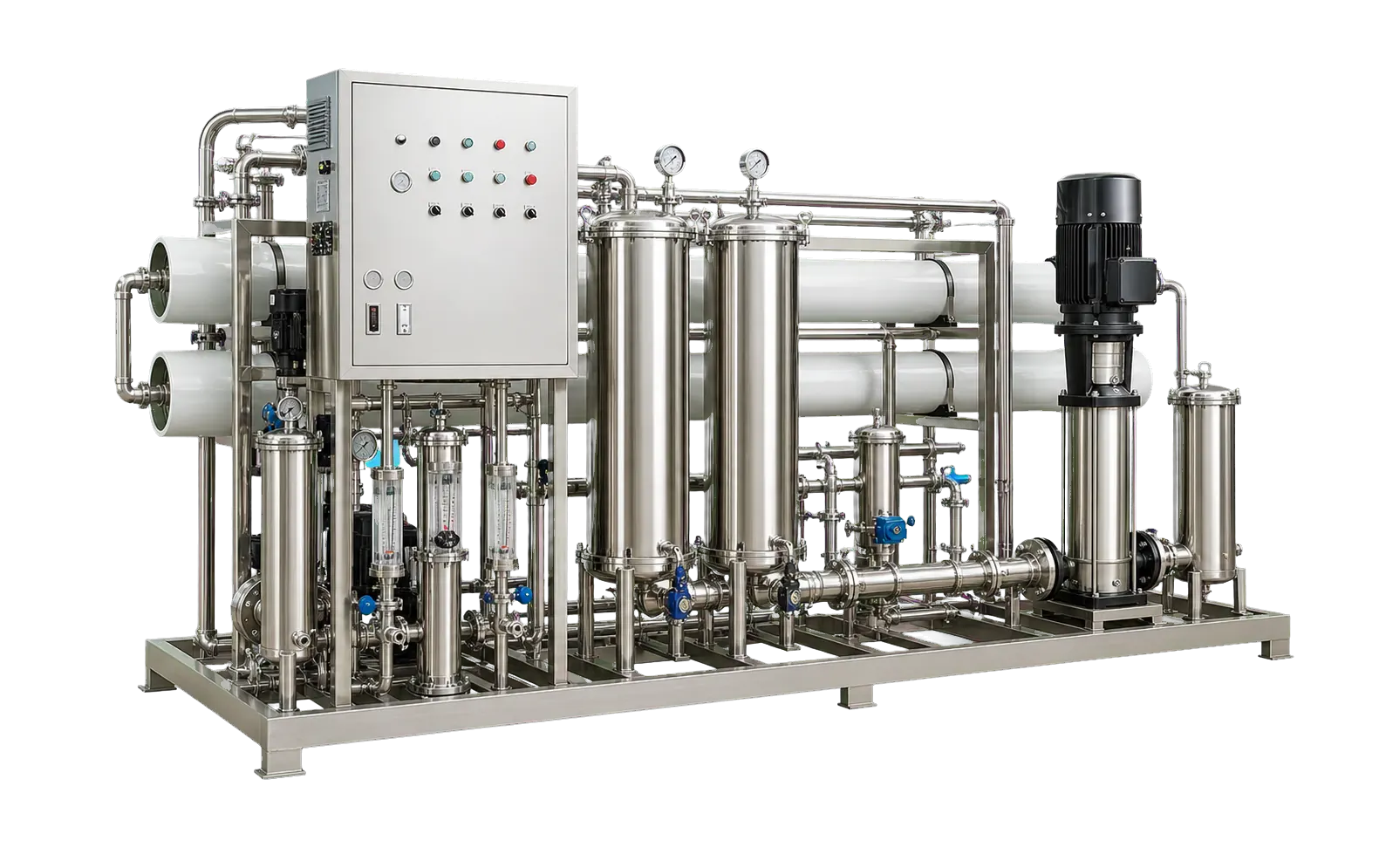
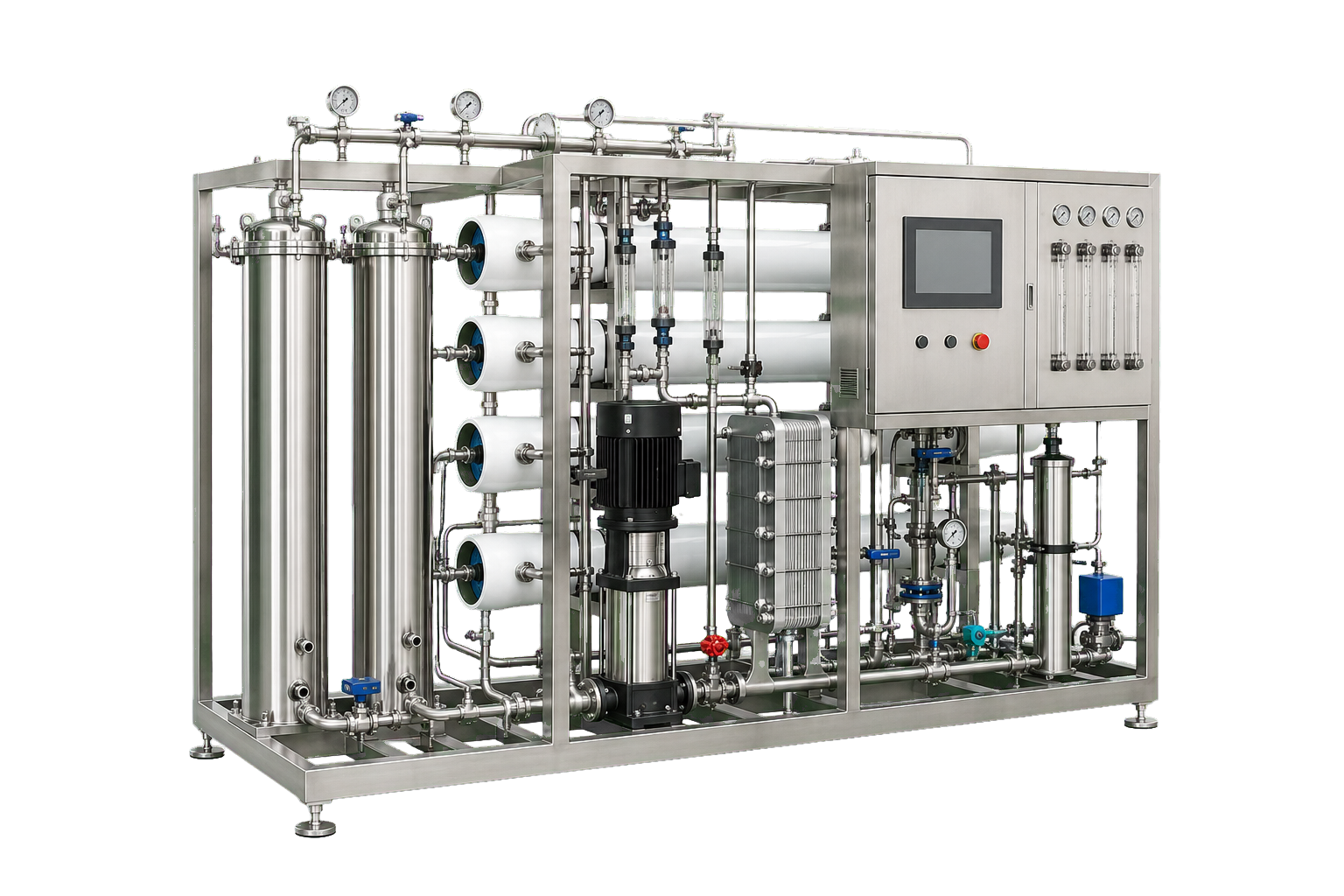
RO + EDI Ultrapure Water Equipment

A complete ultrapure-water route combining pretreatment, double-pass RO and EDI polishing, with optional polishing resin and distribution loop.

Quick quotation

Confirm this equipment for your project

Send source water, flow rate, voltage and target quality. We will confirm whether this model fits before quotation.

WhatsApp engineer
  • ProcessPretreatment + double-pass RO + EDI
  • EDI feed conductivityTypically <20 uS/cm; module supplier limit applies
  • EDI feed hardnessTypically <1 mg/L as CaCO3
  • EDI feed CO2Controlled by project pretreatment and degassing review
  • Product resistivity15-18 Mohm.cm reference under suitable conditions
  • Product conductivity0.055-0.067 uS/cm reference at 25 C

Factory direct supply, project configuration, packing and voltage checked before price.
PARAMETERS

Technical Specifications

ParameterValue
ProcessPretreatment + double-pass RO + EDI
EDI feed conductivityTypically <20 uS/cm; module supplier limit applies
EDI feed hardnessTypically <1 mg/L as CaCO3
EDI feed CO2Controlled by project pretreatment and degassing review
Product resistivity15-18 Mohm.cm reference under suitable conditions
Product conductivity0.055-0.067 uS/cm reference at 25 C
RecoveryRO and EDI recovery configured separately
ControlPLC with RO/EDI interlocks, quality divert and alarms
Wetted materialsUPVC, 304/316L stainless steel and PVDF by section
APPLICATIONS

Typical Applications

ApplicationWhere this equipment fits
Application 1Electronics and semiconductor support water
Application 2Laboratory and analytical water
Application 3Power-plant chemical water
Application 4Precision manufacturing and high-purity process water
PROCESS FLOW

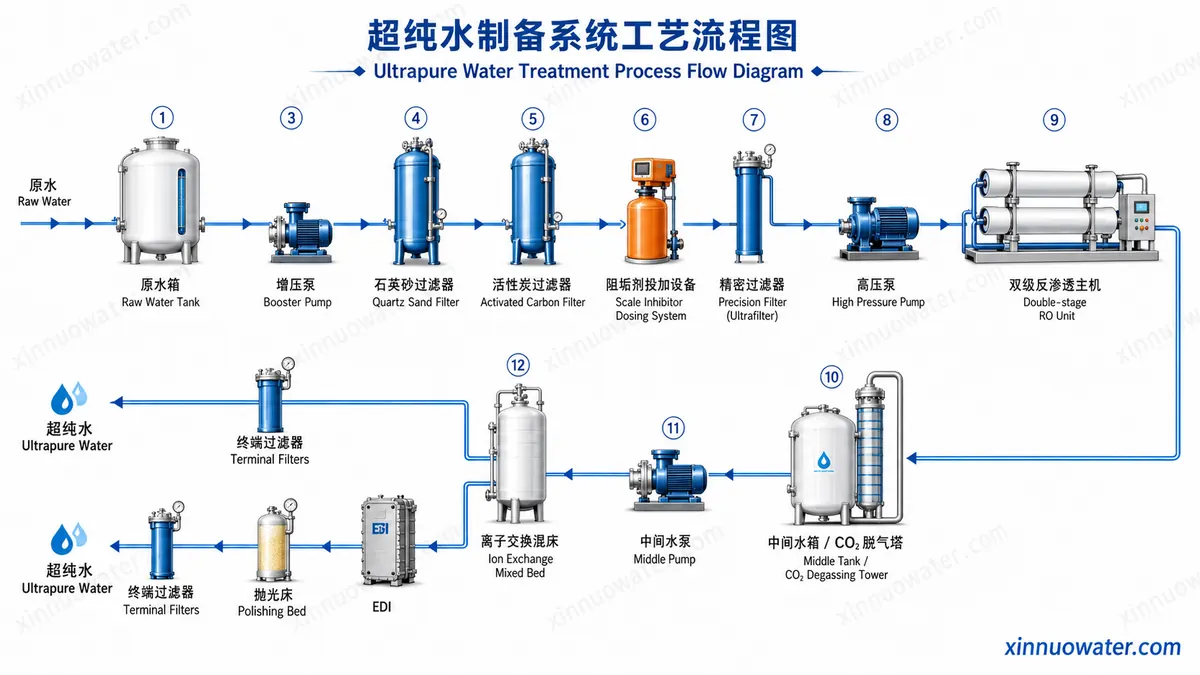
RO + EDI ultrapure-water process

Pretreatment and double-pass RO reduce salts, hardness, organic loading and particles before EDI. The EDI module continuously removes remaining ions using ion-exchange media, selective membranes and direct current. Product water can then enter a protected tank, polishing stage and distribution loop.

  • Pretreatment and double-pass RO
  • EDI feed tank and delivery pump
  • EDI modules and DC power supply
  • Conductivity and resistivity instruments
  • Quality-divert and recirculation valves
  • Ultrapure-water tank with vent filtration
  • Optional polishing resin, UV and terminal filtration
  • PLC cabinet and loop controls
RO + EDI Ultrapure Water Equipment process flowchart
RO + EDI Ultrapure Water Equipment process route used for engineering discussion before quotation.
WATER TREATMENT PRINCIPLE

How EDI polishes RO permeate

EDI combines ion-exchange resin, ion-selective membranes and a DC electric field to continuously transfer remaining ions from the dilute stream to the concentrate stream.

The EDI module depends on stable RO permeate. Hardness, CO2, silica, chlorine, organics and temperature must remain within the selected module limits.

Final quality claims must be tied to the complete feed specification, instrumentation and distribution design.

WHY THIS ROUTE

Practical advantages for selection

  • Continuous deionization without routine chemical regeneration
  • High-purity output with automatic quality monitoring
  • Lower chemical handling than regenerated mixed-bed systems
  • Expandable storage, polishing and loop options
MODEL RANGE

Available Configurations

Model rangeBest fitSelection note
Compact RO + EDI skidLaboratory and small precision linesModule selected from final quality and peak demand
Industrial RO + EDI systemElectronics, power and continuous productionMultiple EDI modules with duty and expansion planning
RO + EDI + polishing loopCritical use-point qualityAdds polishing resin, UV, terminal filter and sanitary distribution
PROJECT OPTIONS

Configuration Options

  • Membrane degassing
  • Polishing mixed-bed resin
  • 185/254 nm UV
  • Sanitary storage and loop
  • Online TOC, silica or sodium monitoring
QUOTE DATA

Before quotation, send these details

  • Required product-water flow and daily operating hours
  • Raw-water source, TDS and full analysis report when available
  • Target conductivity, resistivity or application standard
  • Destination country, voltage, phase and frequency
  • Installation space, tank arrangement and connection points
  • Required automation, monitoring and installation support
  • Final resistivity, silica, TOC or other use-point limits
  • Storage volume, loop length, return flow and use-point count
EDI REFERENCE DATA

Desalination characteristics used for discussion.

These values are reference indicators for engineering communication. Final output depends on feed water condition, operating control and selected modules.

ParameterInfluentOutfluentRemoval Rate (%)
Conductivity (uS/cm)5-200.055-0.067Feed dependent
Resistivity (Mohm.cm)RO permeate15-18At 25 C reference
SilicaProject analysisModule and polishing dependentFeed dependent
BUYER QUESTIONS

Questions buyers usually ask before quotation.

Use these checks to decide whether the route is close enough before sending water data.

Can EDI treat raw water directly?

No. EDI requires controlled RO permeate and must be protected from hardness, chlorine, particles, organics and excess CO2.

Is 18.2 Mohm.cm guaranteed at every use point?

No. EDI outlet, storage, piping, temperature, TOC and use-point contamination all affect final resistivity.

Does EDI need chemicals?

Routine acid and alkali regeneration is not required, but upstream dosing and periodic cleaning may still be needed for the complete system.