
Small Bottled Water Plant
Plan the RO water-treatment route for a small bottled water plant from source analysis, bottle output, shifts, storage, hygiene controls and filling-line interfaces.
When this solution is appropriate.
This solution covers water treatment before hygienic storage and filling. The treatment skid alone is not a complete licensed bottling plant; room hygiene, packaging, filling equipment, local approvals and operating controls remain part of the overall project.
- Use single-stage RO when feed conditions and the local product-water target can be met with one membrane pass.
- Use double-stage RO when lower conductivity or additional desalination stability is required.
- Size treatment and storage from bottles per hour, production shifts, cleaning demand and filling-line operating efficiency.
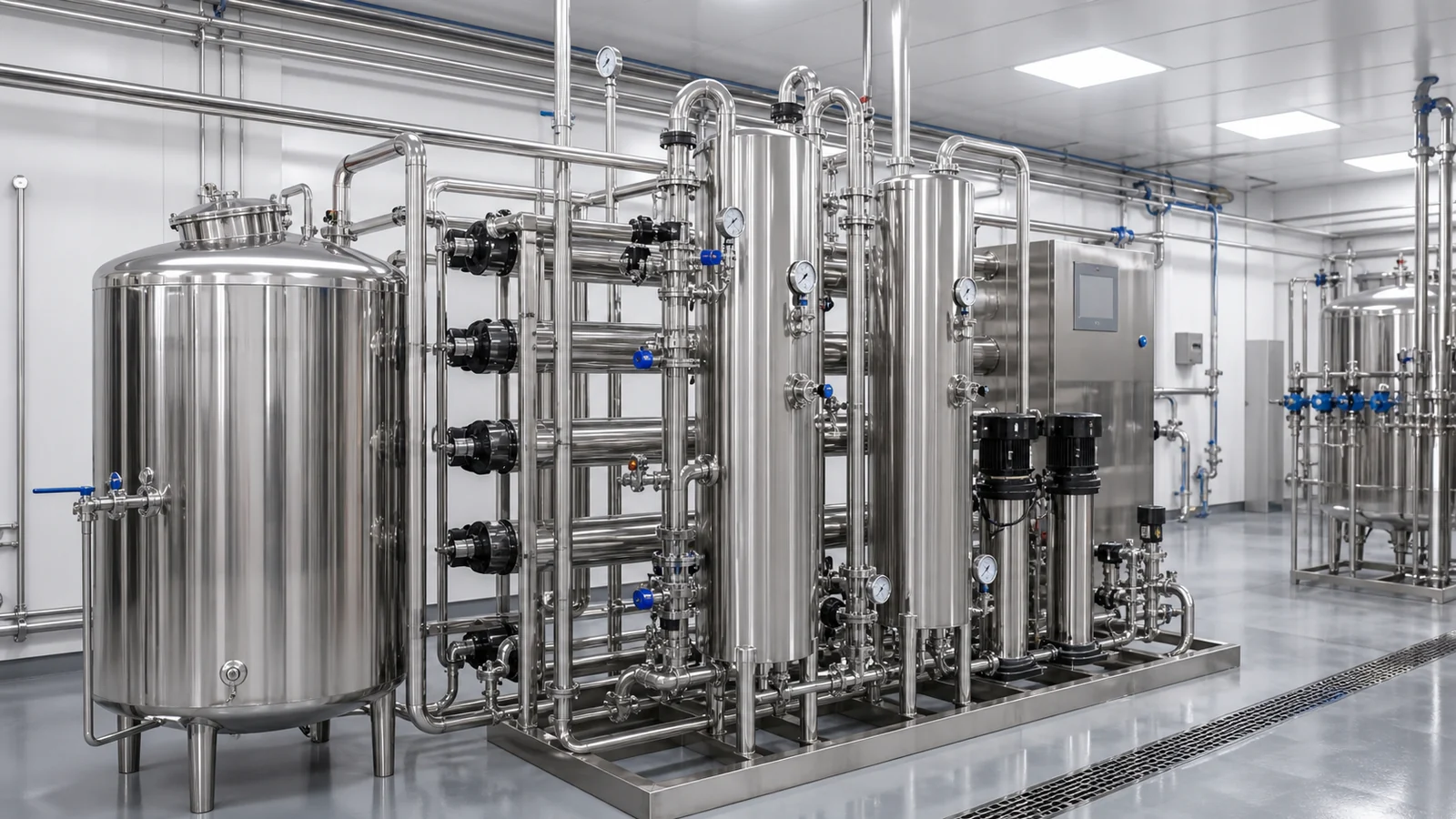
Data that controls the final configuration.
These inputs determine pretreatment, process stages, equipment size, storage and control scope before a technical quotation is confirmed.
- Source water
- Provide a current analysis and identify municipal, well or surface-water feed.
- Package output
- State bottle sizes, bottles per hour, shifts and planned product formats.
- Water requirement
- Identify the applicable local drinking-water and packaged-water requirements.
- Storage
- Confirm tank volume, maximum holding time, venting and cleaning approach.
- Filling interface
- Provide filling-line feed pressure, flow, connection and clean-in-place needs.
- Workshop
- Share room layout, hygiene zones, drains, voltage and available installation access.
Recommended treatment sequence.
Optional stages are included only when the feed analysis, operating profile or final water requirement supports them.
- Source-water pretreatmentControl particles, hardness, chlorine and scaling risk from the analysis.
- Reverse osmosisUse single-pass or double-pass RO according to the target water quality.
- Ultraviolet treatmentProvide a non-residual disinfection barrier where required by the process plan.
- Ozone treatmentSupport hygienic storage or package control when included in the approved process.
- Hygienic product tankBuffer treatment output and protect water before filling.
- Filling-line interfaceDeliver the required pressure and flow to rinsing, filling and capping equipment.
Engineering values to confirm during selection.
These are design references, not unconditional guarantees. Final values depend on the supplied water analysis, equipment selection and operating conditions.
| Parameter | Reference | Design note |
|---|---|---|
| Source analysis | Current report required | Defines pretreatment, RO passes and expected recovery. |
| Bottle sizes | Project-specific | Used with bottles per hour to calculate net product-water demand. |
| Line output | Bottles per hour | Include line efficiency, rinse demand, cleaning and production losses. |
| Production shifts | Hours per day | Determines treatment flow, storage and recovery time. |
| Storage time | Project-specific | Affects tank volume, disinfection and water-age controls. |
| Water requirement | Local authority and buyer confirmed | The complete facility must be reviewed against applicable requirements. |
| Filling pressure and flow | Line supplier data | Defines final delivery-pump and interface sizing. |
Core equipment and controls.
- Pretreatment selected from the source-water report
- Single-stage or double-stage RO skid with online conductivity monitoring
- Product-water tank interface and delivery pump within agreed battery limits
- PLC controls for production, flushing, level and quality divert
- Connections for selected UV, ozone and filling-line interfaces
Items selected from project data.
- Double-stage RO for a lower conductivity target
- UV and ozone treatment modules
- Hygienic product tank and recirculation
- Bottle-rinsing water allowance and filling-line delivery set
- Remote production and conductivity monitoring
Commissioning and maintenance priorities.
- Commission the RO skid, product tank, disinfection and filling interface as one production route.
- Verify tank cleaning, venting, turnover and residual-disinfection controls before routine production.
- Record RO recovery, conductivity, UV intensity or ozone readings and filling-line delivery pressure.
- Maintain local hygiene, packaging and product-release procedures outside the treatment-skid scope.
Questions before equipment selection.
What information is needed to size bottled-water treatment?
Provide source analysis, bottle sizes, bottles per hour, shifts, rinse and cleaning demand, storage plan, local requirements and filling-line data.
Does the RO skid include a complete licensed bottling plant?
No. Water treatment is one part of the facility; hygiene zoning, filling, packaging, approvals, quality control and operating procedures must also be addressed.
What should be tested at commissioning?
Verify treatment flow and quality, tank turnover, disinfection controls, delivery pressure and the interface with rinsing, filling and capping equipment.
Compare the product routes for this solution.
Turn the application data into a quotation.
Send the source-water report, bottle sizes, bottles per hour, shifts, local water requirement, storage plan, filling-line data, room layout, voltage and destination.