
Greenhouse & Hydroponic Irrigation
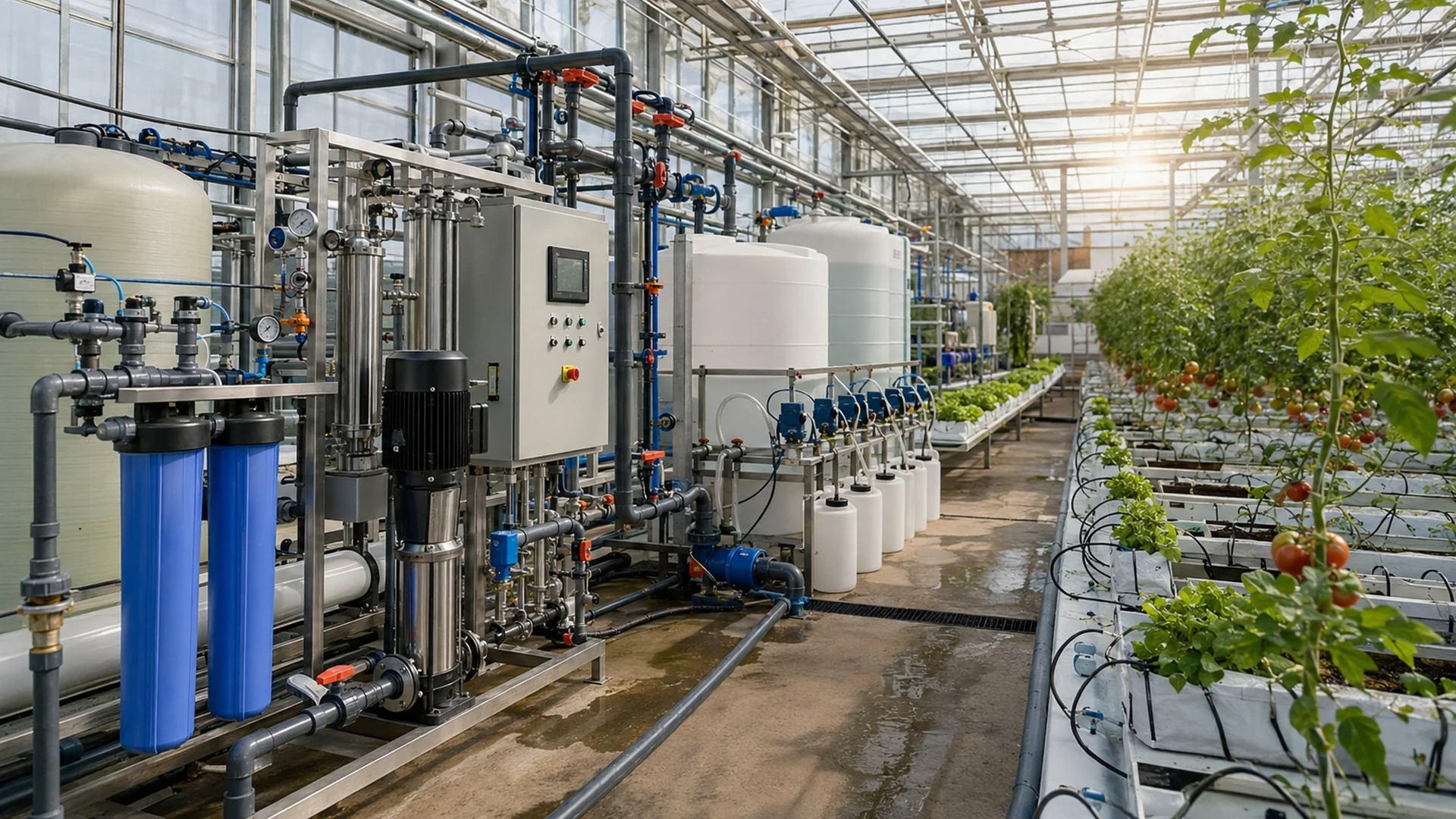
Plan RO water treatment for greenhouse and hydroponic irrigation using salinity, sodium, chloride, bicarbonate, demand, blending and fertigation requirements.
When this solution is appropriate.
This route conditions irrigation source water when salinity, sodium, chloride, bicarbonate, hardness or variable turbidity interferes with nutrient management. Crop recipes and yield guarantees remain the responsibility of the grower and agronomic adviser.
- Use RO to reduce dissolved salts that cannot be controlled by particle filtration alone.
- Add UF before RO when suspended solids, colloids or seasonal source-water changes threaten membrane operation.
- Use controlled permeate blending so the grower's fertigation system receives a stable base-water target.
Data that controls the final configuration.
These inputs determine pretreatment, process stages, equipment size, storage and control scope before a technical quotation is confirmed.
- Irrigation analysis
- Provide EC or TDS, sodium, chloride, bicarbonate, hardness, pH, silica, iron and turbidity.
- Crop sensitivity
- State crop groups, growth stages and the agronomic base-water target.
- Demand profile
- Provide daily demand, peak irrigation flow, zones, cycles and seasonal maximum.
- Blending
- Define permeate-to-raw-water blending target and acceptable source-water variation.
- Drainage
- Describe reject-water disposal, recirculation and greenhouse drainage constraints.
- Fertigation interface
- Confirm storage, nutrient dosing, controls and irrigation-system inlet pressure.
Recommended treatment sequence.
Optional stages are included only when the feed analysis, operating profile or final water requirement supports them.
- Source filtrationRemove coarse particles and protect pumps and downstream membrane equipment.
- UltrafiltrationStabilize suspended-solids and colloid loading for variable source water.
- Reverse osmosisReduce salinity, sodium, chloride, bicarbonate and hardness.
- Permeate storageBuffer membrane production against irrigation peaks.
- Controlled blendingMix permeate and source water to the agreed base-water target.
- Grower fertigationAdd nutrients and control recipes using the grower's agronomic system.
- Irrigation distributionDeliver conditioned water to zones at the required pressure and schedule.
Engineering values to confirm during selection.
These are design references, not unconditional guarantees. Final values depend on the supplied water analysis, equipment selection and operating conditions.
| Parameter | Reference | Design note |
|---|---|---|
| Salinity or EC | Laboratory result and seasonal range | Primary basis for RO rejection, recovery and blending. |
| Sodium and chloride | Crop-specific review | Confirm acceptable base-water limits with the agronomic adviser. |
| Bicarbonate and hardness | Laboratory result required | Affects alkalinity management, scaling and nutrient control. |
| Turbidity and SDI | Source-specific | Controls filtration and optional UF pretreatment. |
| Daily demand | Peak-season value | Used with irrigation windows to size RO and storage. |
| Blending target | Grower-confirmed | Set the stable base-water quality before nutrient dosing. |
| Drainage plan | Site-confirmed | Must accommodate RO concentrate and greenhouse water balance. |
Core equipment and controls.
- Source filtration and feed pumping for the confirmed water source
- Single-stage RO skid with pressure, flow and conductivity monitoring
- Permeate storage and delivery interfaces within agreed battery limits
- PLC controls for production, flushing, levels and alarms
- Blending connection and signal interface to the grower's fertigation system
Items selected from project data.
- UF pretreatment for variable turbidity or colloids
- Automated permeate/source blending by conductivity
- Larger storage for short irrigation windows
- Remote conductivity, tank-level and alarm monitoring
- Reject-water recovery review where chemistry and site use permit
Commissioning and maintenance priorities.
- Commission RO recovery and blending against the agreed base-water quality, not a crop-yield promise.
- Trend source and blended-water conductivity as seasonal water quality changes.
- Coordinate tank level and delivery pressure with irrigation zones and fertigation cycles.
- Review membrane scaling, concentrate disposal and filter or UF cleaning through peak season.
Questions before equipment selection.
What water data is needed for greenhouse RO selection?
Provide a full analysis including salinity, sodium, chloride, bicarbonate, hardness, silica, iron and turbidity, plus daily and peak irrigation demand.
Does RO guarantee crop performance or replace agronomic planning?
No. RO provides a controllable base water; crop recipes, blending targets, nutrient management and yield decisions belong to the grower and agronomic adviser.
What should be checked at commissioning?
Verify RO recovery, permeate quality, storage capacity, blending accuracy, delivery pressure, fertigation interfaces and concentrate drainage.
Compare the product routes for this solution.
Turn the application data into a quotation.
Send the full irrigation-water analysis, crop sensitivity information, daily and peak demand, irrigation schedule, blending target, storage, drainage, fertigation interface and voltage.