
Boiler Feed Pretreatment System
Plan boiler feed water pretreatment from pressure class, makeup rate and feed chemistry, using filtration, softening, optional UF and RO where required.
When this solution is appropriate.
This solution covers water preparation before downstream boiler-house conditioning. It can reduce particles, hardness and dissolved solids, but it is not a complete boiler chemistry, deaeration or pressure-vessel package unless those items are explicitly included.
- Use clarification, media filtration or UF where suspended solids and source-water variation threaten downstream equipment.
- Use softening or chemical dosing where hardness and scaling risk must be controlled before RO or boiler treatment.
- Use RO when dissolved-solids, alkalinity or silica reduction is required by the downstream boiler-water program.
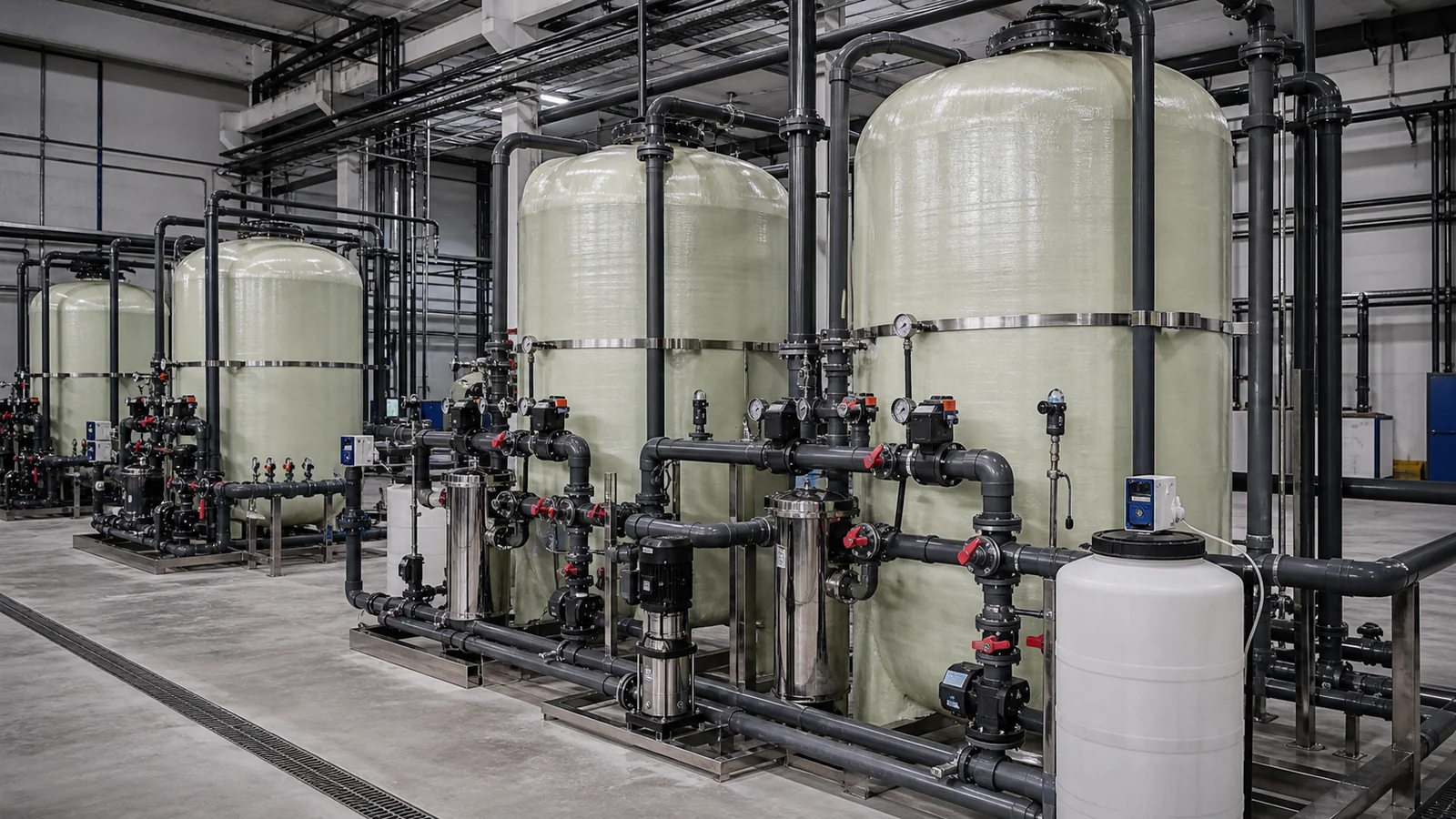
Data that controls the final configuration.
These inputs determine pretreatment, process stages, equipment size, storage and control scope before a technical quotation is confirmed.
- Boiler duty
- Provide pressure class, steam load, condensate return and makeup percentage.
- Feed analysis
- Include hardness, alkalinity, silica, iron, manganese, turbidity, TDS, pH and temperature.
- Flow demand
- State average and peak makeup flow, operating hours and redundancy requirement.
- Downstream treatment
- Describe deaeration, chemical dosing and any polishing supplied by the boiler-house contractor.
- Source variation
- Identify seasonal turbidity, iron or organic changes that affect filtration and cleaning.
- Site interfaces
- Confirm tank levels, pressures, drains, chemical area, voltage and control signals.
Recommended treatment sequence.
Optional stages are included only when the feed analysis, operating profile or final water requirement supports them.
- Clarification or media filtrationReduce suspended solids when required by the source-water analysis.
- Iron and manganese removalOxidize and filter metals when concentrations threaten resin or membranes.
- Softening or dosingControl hardness and scaling risk according to the selected downstream route.
- Cartridge filtrationProtect membrane equipment from remaining particulate matter.
- UltrafiltrationStabilize variable surface-water or reuse feed before RO.
- Reverse osmosisReduce TDS, alkalinity and silica where required by the boiler-water design.
- Boiler-house treatmentComplete deaeration and chemical control under the project owner's boiler program.
Engineering values to confirm during selection.
These are design references, not unconditional guarantees. Final values depend on the supplied water analysis, equipment selection and operating conditions.
| Parameter | Reference | Design note |
|---|---|---|
| Boiler pressure class | Project-specific | Drives the downstream water-quality requirement and treatment responsibility. |
| Makeup percentage | Project-specific | Use with steam load and condensate return to determine plant demand. |
| Hardness | Laboratory result required | Controls softener capacity, leakage target and scale risk. |
| Alkalinity and silica | Laboratory result required | Used to assess cycles, RO need and downstream chemistry. |
| Iron and turbidity | Laboratory and seasonal data | Controls oxidation, filtration and optional UF selection. |
| Feed temperature | Design minimum and maximum | Affects membrane flow, viscosity and softener performance. |
| Design flow | Average and peak required | Include regeneration, backwash and redundancy allowances. |
Core equipment and controls.
- Feed pumps and pretreatment vessels selected from the confirmed analysis
- Softening or dosing equipment within the agreed pretreatment battery limits
- Cartridge filtration and optional UF or RO skids when specified
- Flow, pressure and conductivity monitoring appropriate to the selected route
- PLC sequencing for service, backwash, regeneration, flushing and alarms
Items selected from project data.
- Duty/standby softeners or filters for continuous operation
- UF pretreatment for variable surface-water or reuse feed
- Single-stage RO for dissolved-solids reduction
- Chemical storage, dosing and neutralization interfaces
- Remote status signals to the boiler-house control system
Commissioning and maintenance priorities.
- Verify filter backwash, softener regeneration and chemical interlocks before admitting water downstream.
- Record hardness leakage, turbidity, iron, conductivity and pressure drop at commissioning.
- Coordinate RO recovery and concentrate routing with the boiler-water mass balance.
- Keep downstream deaeration and boiler chemical treatment under the approved boiler-house operating program.
Questions before equipment selection.
What data is needed for boiler feed pretreatment selection?
Provide boiler pressure class, steam and makeup demand, condensate return, a full feed-water analysis and the downstream deaeration and chemistry arrangement.
Is this page a complete boiler-water chemistry package?
No. The scope is pretreatment and membrane preparation unless downstream deaeration, dosing and boiler chemistry are explicitly defined in the project.
What should be checked during commissioning?
Verify backwash and regeneration sequences, hardness leakage, turbidity, iron, conductivity, pressure drop, RO recovery and all downstream interlocks.
Compare the product routes for this solution.
Turn the application data into a quotation.
Send the feed-water report, boiler pressure class, steam and makeup demand, condensate return, downstream treatment arrangement, voltage and site interfaces.