
Ultrapure Water EDI System
Configure a double-pass RO and EDI ultrapure water system from feed conductivity, hardness, CO2, silica, final resistivity and distribution requirements.
When this solution is appropriate.
This route supports laboratory, electronics-related, precision-cleaning, battery-material and other high-purity applications. EDI must receive stable RO permeate; it is not a direct raw-water treatment stage.
- Use double-pass RO to reduce ionic load and protect EDI from unstable feed conditions.
- Review CO2, silica, hardness, organics and temperature before selecting the EDI module and recovery.
- Add UV, polishing resin or a high-purity loop when the use-point target is stricter than the nominal EDI outlet target.
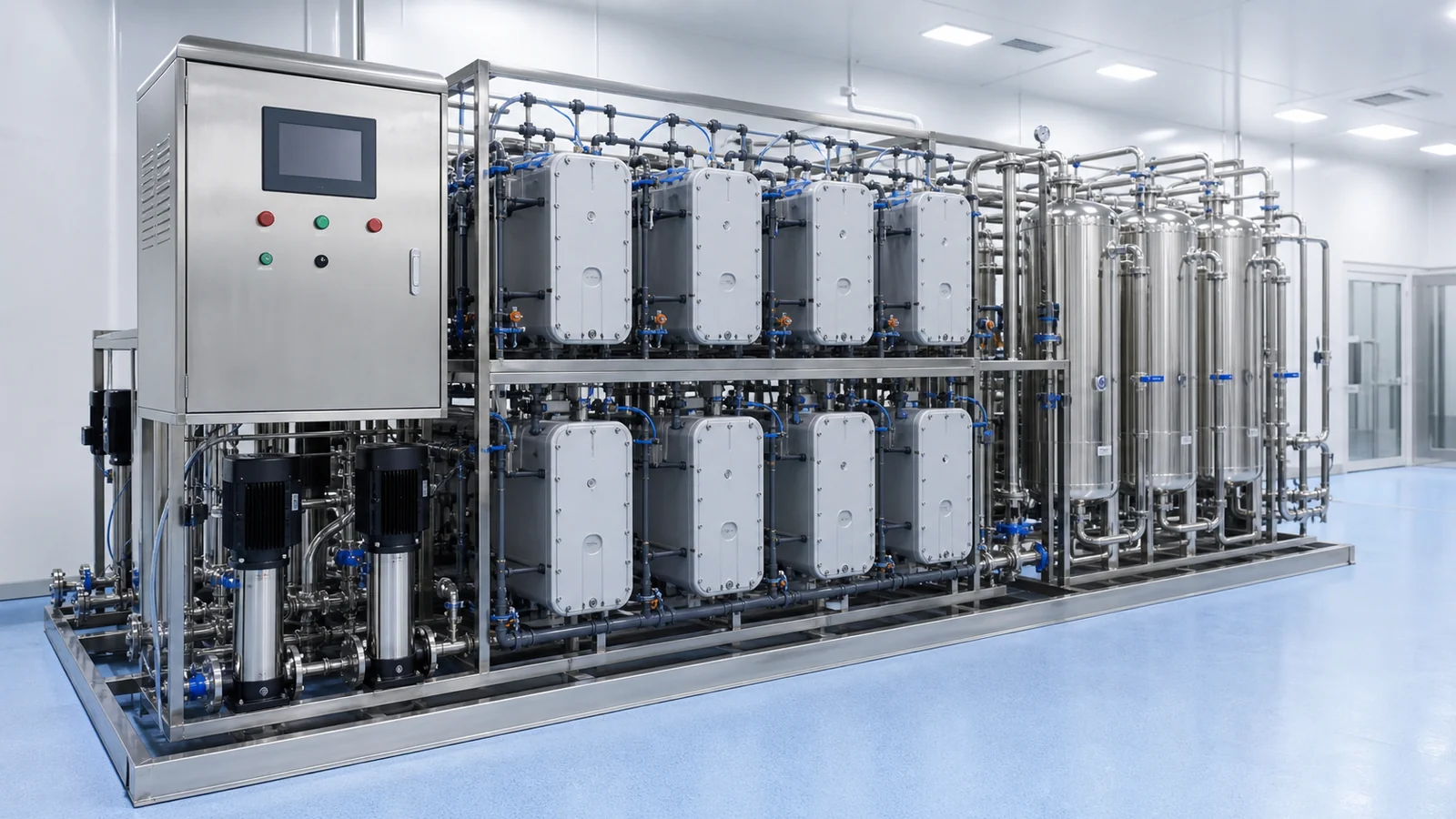
Data that controls the final configuration.
These inputs determine pretreatment, process stages, equipment size, storage and control scope before a technical quotation is confirmed.
- Feed analysis
- Provide conductivity, hardness, alkalinity, silica, CO2 indicators, TOC expectation and temperature.
- Final quality
- Define resistivity or conductivity at the EDI outlet and at the actual use point.
- Demand profile
- State continuous flow, peaks, operating hours, storage tolerance and future expansion.
- Distribution
- Confirm tank material, loop length, return flow, use points and contamination controls.
- Monitoring
- Identify required conductivity, resistivity, silica, sodium or TOC instruments.
- Utilities
- Confirm voltage, drain, cooling or room-temperature limits and available footprint.
Recommended treatment sequence.
Optional stages are included only when the feed analysis, operating profile or final water requirement supports them.
- Feed pretreatmentRemove particles, hardness risk, chlorine and other loads that threaten the RO stages.
- Double-pass ROReduce dissolved salts and provide stable low-conductivity EDI feed.
- DecarbonationReduce CO2 loading when feed alkalinity and target performance require it.
- EDI polishingContinuously transfer remaining ions using resin, selective membranes and DC power.
- UV and final polishingControl organics or polish resistivity for stricter use-point requirements.
- High-purity tank and loopProtect product water from air, materials and stagnant distribution conditions.
Engineering values to confirm during selection.
These are design references, not unconditional guarantees. Final values depend on the supplied water analysis, equipment selection and operating conditions.
| Parameter | Reference | Design note |
|---|---|---|
| EDI feed conductivity | Typically below 20 uS/cm | The selected module supplier limit and feed chemistry govern final acceptance. |
| EDI feed hardness | Typically below 1 mg/L as CaCO3 | Stable low hardness protects the concentrate and electrode compartments. |
| CO2 | Project review required | Excess CO2 consumes EDI capacity and can limit resistivity. |
| Silica | Project review required | Feed and product limits depend on module loading and any final polishing. |
| Product resistivity | 15-18 Mohm.cm reference | Nominal target under suitable conditions, measured at 25 C reference. |
| Product conductivity | 0.055-0.067 uS/cm reference | Actual use-point quality also depends on storage and distribution. |
| EDI recovery | Module and chemistry dependent | Set separately from RO recovery and concentrate management. |
Core equipment and controls.
- Pretreatment and double-pass RO sized for the confirmed EDI feed requirement
- EDI feed tank, delivery pump, EDI module and DC power supply
- Conductivity and resistivity monitoring with quality-divert logic
- Product tank interface and controlled recirculation connections
- PLC interlocks covering RO quality, EDI operation, level and alarms
Items selected from project data.
- Membrane degassing or other CO2 control
- 185/254 nm UV and final mixed-bed polishing
- Sanitary or high-purity storage and distribution loop
- Online TOC, silica or sodium monitoring
- Duty/standby modules or planned expansion connections
Commissioning and maintenance priorities.
- Do not energize EDI until RO permeate quality, flow and concentrate conditions are within the module limits.
- Record product and concentrate flow, pressure, current, voltage, conductivity and resistivity at startup.
- Trend hardness leakage, CO2 indicators and RO salt passage when EDI resistivity declines.
- Protect the product tank and loop from air contamination, incompatible materials and long stagnation periods.
Questions before equipment selection.
What information is needed to size an EDI system?
Provide RO feed and permeate data, hardness, alkalinity or CO2 indicators, silica, temperature, target resistivity, flow profile and distribution requirements.
Can EDI produce 18 Mohm.cm from untreated raw water?
No. EDI requires controlled RO permeate, and final resistivity also depends on CO2, silica, organics, temperature, storage and distribution.
What baseline readings should be kept after startup?
Record feed, product and concentrate flows and pressures, current, voltage, conductivity, resistivity and temperature for future troubleshooting.
Compare the product routes for this solution.
Turn the application data into a quotation.
Send the full water report, final resistivity or conductivity target, capacity, demand profile, tank and loop details, monitoring needs and voltage.