
An industrial RO system should be selected from source-water analysis, target product quality and net production demand first. Capacity alone cannot determine pretreatment, membrane array, RO pass count, controls or the installation boundary.
Start with a recent water analysis and the quality required at the actual point of use. Then size for net permeate during operating hours, account for pretreatment and recovery, and define what the equipment supplier must include.
8 Project Factors for Industrial RO Selection
- Source WaterIdentify whether the feed is municipal water, groundwater or another approved industrial source, then provide TDS, hardness, alkalinity, silica, iron, manganese, turbidity, temperature and other relevant analysis values.
- Target Water QualityState the application and measurable point-of-use target, such as conductivity, resistivity or a project specification. This decides whether one RO pass, two passes or RO followed by EDI is appropriate.
- Net flow and operating scheduleSpecify usable product-water flow, daily demand, peak demand and operating hours. Feed-pump and membrane sizing must also cover reject flow and planned flushing.
- Pretreatment dutyMatch filtration and chemical conditioning to fouling, scaling and oxidant risks. A generic pretreatment train should not be accepted without checking the analysis.
- Recovery and concentrate routeHigher recovery can reduce feed use but increases concentration at the membrane surface. Recovery must stay inside scaling, pressure and membrane limits.
- Materials and hygiene boundaryDefine frame, pressure-pipe and product-water contact materials from the application, environment and cleaning method rather than appearance alone.
- Controls and instrumentsAgree on conductivity monitoring, pressure and flow indication, low-pressure and high-pressure protection, tank-level interlocks, flushing and alarm logic.
- Utilities and installation scopeConfirm voltage and frequency, feed pressure, drain, floor area, access, ambient conditions, tanks, interconnecting pipework and commissioning responsibilities.
Source Water and the Pretreatment Route
TDS indicates the dissolved-ion load, but it does not describe every design risk. Hardness and alkalinity affect scaling potential; iron, manganese and turbidity can foul media and membranes; oxidants may damage certain membrane materials; temperature changes permeate flow. A complete analysis allows the supplier to identify which values need treatment or further testing.
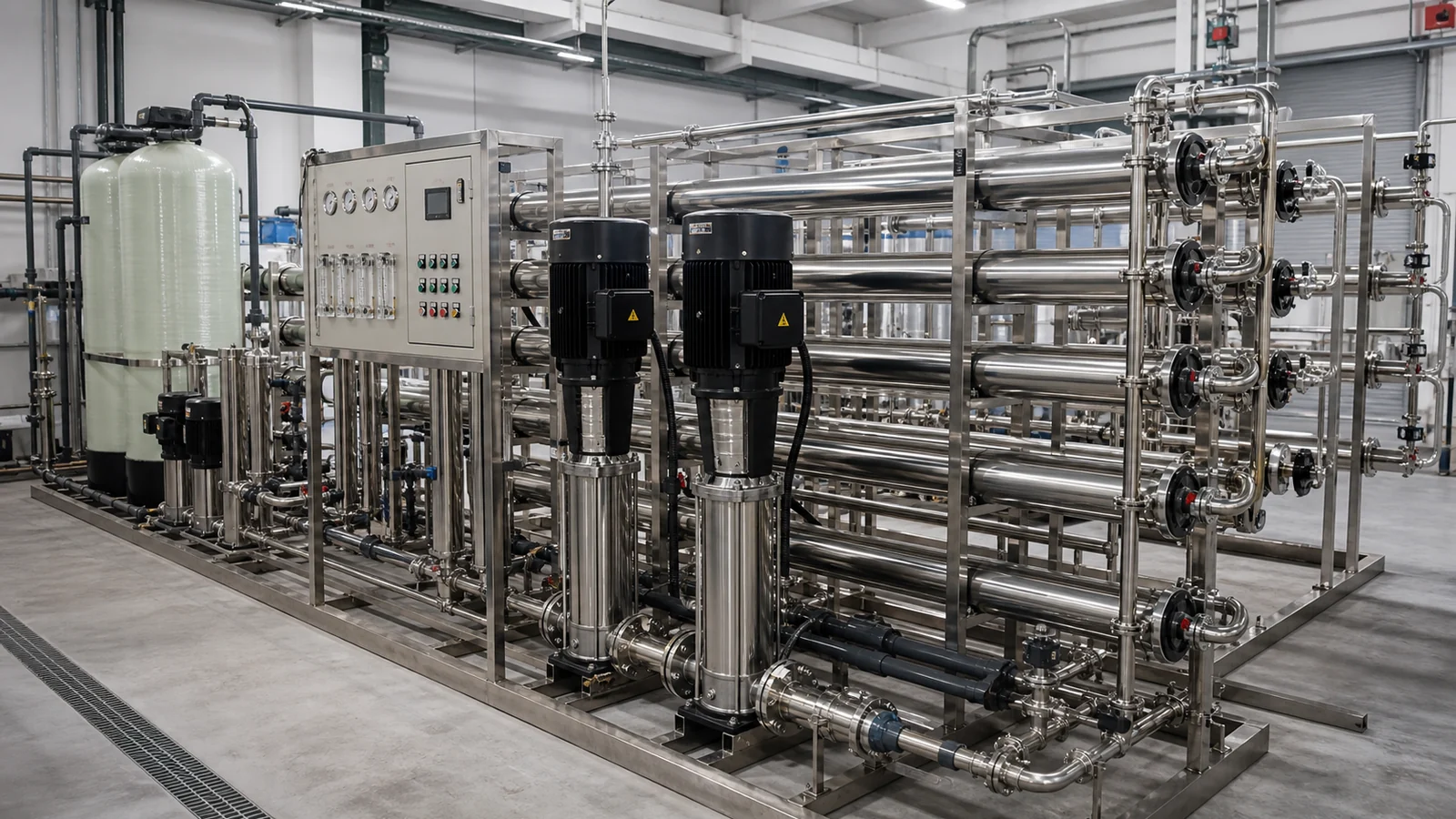
A common route may contain the following blocks, but each block is confirmed or removed from project data:
- Feed and dosing
- Media filtration
- Cartridge filtration
- High-pressure RO
- Product-water tank
UF may be selected ahead of RO when suspended solids, colloids or variable turbidity justify a membrane pretreatment barrier. That decision is different from asking RO to remove dissolved salts. See the UF versus RO comparison for the separation roles.
Target Water Quality and RO Passes
The product-water requirement must be tied to feed composition and operating conditions. A single-stage RO pure-water system is usually evaluated first for general process-water desalination. A double-stage RO pure-water system sends first-pass permeate through another RO pass when a lower conductivity target or more stable polishing barrier is needed.
No responsible supplier can guarantee one outlet conductivity for every raw water. Membrane rejection, feed temperature, pH, recovery, dissolved gases, membrane age and measurement location all affect the result. Put the design basis and acceptance method in the quotation.
Price Drivers
Industrial RO price changes with more than nominal capacity. Important drivers include feed-water pretreatment, membrane quantity and pressure-vessel arrangement, one or two RO passes, pump duty, materials, instrumentation, control level, tank and distribution scope, electrical standard, documentation, packing, freight boundary and site services.
A lower initial quote may exclude tanks, dosing, instruments, interconnecting pipework or commissioning. Compare quotations line by line against the same net output, water-quality basis and supply boundary. Generic price ranges without those inputs are not reliable project budgets.
Common Mistakes
- Buying by hourly capacity onlyThe same stated flow can hide different feed flow, recovery, membrane loading and redundancy.
- Using TDS as the complete analysisScaling and fouling risks can remain unknown when hardness, alkalinity, silica, metals and turbidity are missing.
- Comparing gross and net outputClarify whether the quoted rate is stable usable permeate under the design temperature and operating schedule.
- Leaving the installation boundary undefinedTanks, pipework, drains, cables, foundations, commissioning and local labor must have named owners.
Recommended Next Step
Send the feed analysis, required net flow, operating hours, application, target quality, voltage and destination. Xinnuo can then compare the single-stage and double-stage routes against the same basis.
Frequently Asked Questions
What information is needed to size an industrial RO system?
Provide a recent feed-water analysis, required net product flow, operating hours, application, target water quality, voltage, destination and installation scope.
Is feed-water TDS enough for an RO quotation?
TDS is useful but not enough for final design. Hardness, alkalinity, silica, iron, manganese, turbidity, temperature and other relevant values may change pretreatment and recovery.
When should a project consider double-stage RO?
Consider a second RO pass when the target conductivity is lower than a single pass can reliably provide from the stated feed, or when the next process needs a more controlled feed.
Can outlet conductivity be guaranteed without a water analysis?
No. A guarantee needs a stated feed composition, temperature, recovery, membrane basis, measurement point and acceptance procedure.