Factory-direct RO, ultrafiltration, ultrapure, purified-water and accessory support for overseas project buyers

Water Softening Equipment

Water Softener System

An automatic sodium-cycle ion-exchange system that removes calcium and magnesium hardness before boilers, RO systems and other scale-sensitive equipment.

Quick quotation

Size the softener from actual hardness load

Send feed hardness, target hardness, peak flow and daily water demand. We will calculate the resin volume, vessel size and regeneration arrangement before quotation.

WhatsApp engineer
  • Exchange mediaSodium-form strong-acid cation resin
  • RegenerationSodium chloride (NaCl) brine
  • Operating pressure0.2-0.6 MPa reference
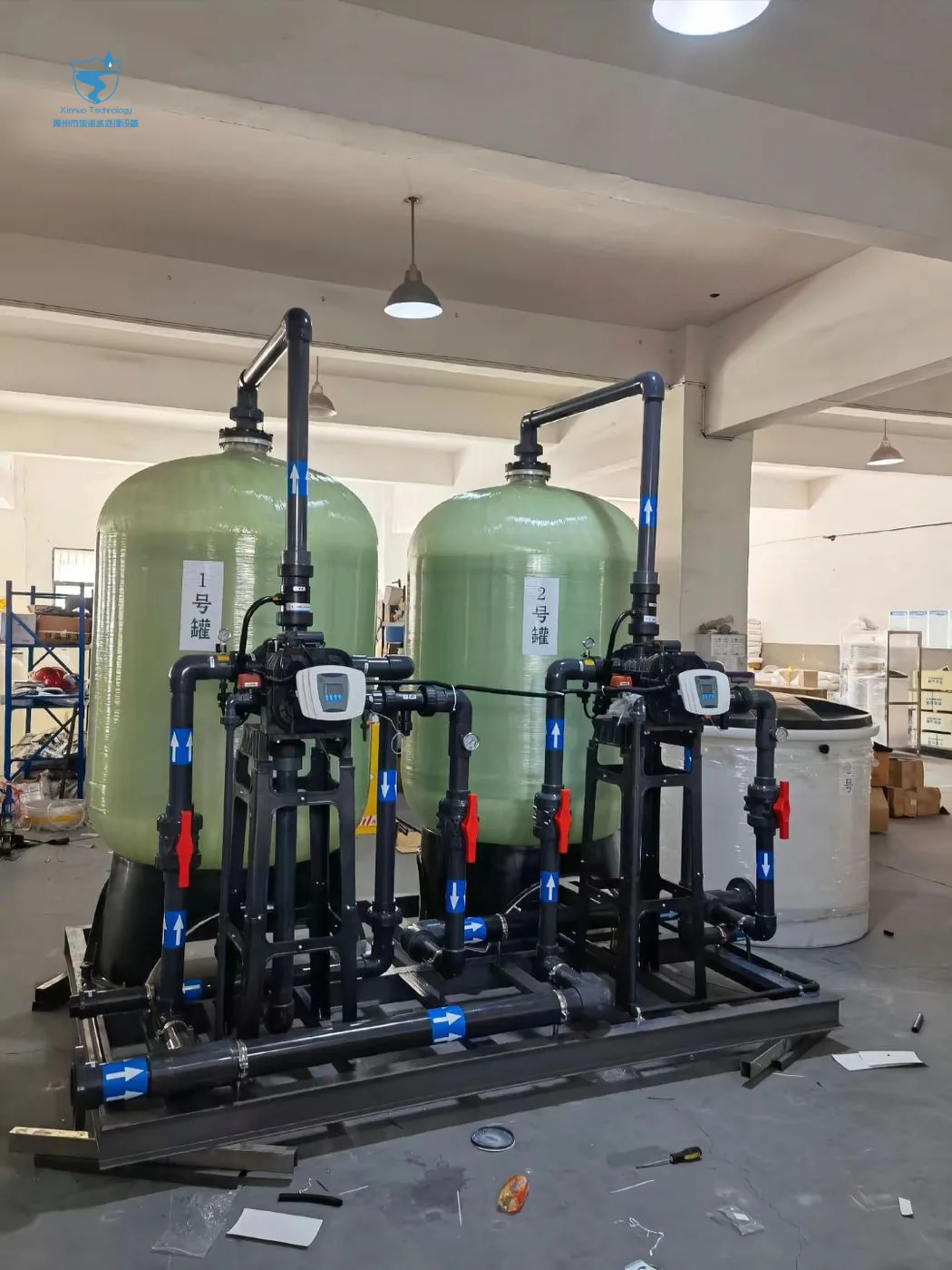
  • ArrangementSingle-tank or twin-tank alternating
  • Vessel materialFRP or stainless steel
  • Control modeMeter-initiated or time-initiated automatic valve

Capacity and regeneration frequency are calculated from hardness load; they are not selected from flow alone.
PARAMETERS

Technical Specifications

ParameterProject reference
Treatment principleSodium-cycle ion exchange for calcium and magnesium hardness removal
Exchange mediaSodium-form strong-acid cation-exchange resin
RegenerantIndustrial-grade sodium chloride (NaCl) brine suitable for the project
Operating pressure0.2-0.6 MPa reference
Feed and target hardnessSpecified in mg/L as CaCO3 and confirmed from a water analysis
Vessel materialFRP or stainless steel selected for site and project requirements
System arrangementSingle-tank intermittent duty or twin-tank alternating continuous duty
Automatic controlFlow-meter initiated or time-initiated service and regeneration cycles
Sizing basisFeed hardness, target hardness, peak flow, daily demand and required regeneration interval
Power supplyMatched to destination voltage, phase and frequency where powered controls are used
APPLICATIONS

Typical Applications

ApplicationSelection purpose
Boiler feed pretreatmentReduce scale-forming hardness before the downstream boiler-water treatment route
RO pretreatmentReduce calcium and magnesium scaling risk before reverse osmosis
Laundry and hotelsReduce hardness deposits in washing, hot-water and service-water systems
Industrial washingControl hardness where scale or spotting affects cleaning operations
Cooling-tower makeupUsed only where the project water-chemistry and cycles-of-concentration plan confirms softening is appropriate
PROCESS FLOW

Service and automatic regeneration cycle

During service, filtered feed water passes through sodium-form resin. The resin exchanges sodium ions for calcium and magnesium until the configured hardness load is reached, then the valve starts regeneration.

  • Feed pump and optional prefiltration
  • Automatic control valve and flow meter
  • Cation-resin pressure vessel
  • Brine tank with salt support grid
  • Hardness test point at the softened-water outlet
  • Softened-water tank or direct downstream connection
  1. ServiceHard water passes through sodium-form resin.
  2. BackwashThe resin bed expands and trapped solids are released.
  3. Brine draw and slow rinseNaCl brine restores the resin to sodium form.
  4. Fast rinseResidual brine and displaced hardness are flushed to drain.
  5. Brine tank refillThe measured refill prepares the next regeneration.
Automatic regeneration returns the selected vessel to service. Twin-tank systems alternate vessels to maintain softened-water supply.
WATER TREATMENT PRINCIPLE

Softening controls hardness, not dissolved salts

The cation resin exchanges calcium and magnesium for sodium. This reduces hardness-related scale while keeping most dissolved ions in the water.

A water softener does not reduce TDS or conductivity and does not replace RO when the project requires desalination, low conductivity or high-purity water.

Feed turbidity, iron, manganese and free chlorine must also be checked because additional pretreatment may be required to protect the resin.

WHY THIS ROUTE

Practical selection advantages

  • Automatic service and regeneration cycles
  • Single-tank and twin-tank arrangements
  • FRP and stainless-steel vessel options
  • Meter-based control aligns regeneration with actual water use
CONFIGURATIONS

Available Configurations

ConfigurationBest fitSelection note
Single-tank automatic softenerSites that can tolerate regeneration downtime or use a softened-water buffer tankCompact route with one resin vessel and one brine tank
Twin-tank alternating softenerContinuous-duty boiler, RO or production pretreatmentOne vessel serves while the other regenerates or remains ready
Project skid with multiple vesselsHigher peak-flow or redundancy requirementsValve arrangement, controls and vessel sequence are engineered from duty data
PROJECT OPTIONS

Configuration Options

  • FRP or stainless-steel resin vessels
  • Meter-initiated or time-initiated automatic valves
  • Single-tank, twin-tank alternating or duty/standby arrangement
  • Feed prefilter, softened-water tank and booster pump
  • Online hardness monitor or manual sampling points
QUOTE DATA

Before quotation, send these details

  • Feed-water hardness in mg/L as CaCO3 and a full analysis when available
  • Required outlet hardness in mg/L as CaCO3
  • Peak flow, average hourly flow and daily water demand
  • Required operating hours and acceptable regeneration interval
  • Application and downstream equipment
  • Feed pressure, available drain and installation space
  • Destination voltage, phase and frequency
  • Preferred vessel material and control arrangement
BUYER QUESTIONS

Water softener questions before quotation

These answers clarify when ion-exchange softening is the correct pretreatment route.

Does a water softener lower TDS or conductivity?

No. It exchanges calcium and magnesium for sodium, so it does not remove TDS. Use RO when dissolved-salt removal or low conductivity is required.

When should I choose a twin-tank system?

Choose twin-tank alternating operation when the process needs continuous softened water and cannot stop while one vessel regenerates.

What determines resin and vessel size?

Feed hardness, outlet-hardness target, peak flow, daily demand and the planned regeneration interval determine the design. Flow alone is not enough.

How much salt will the system use?

Salt consumption depends on resin volume, regeneration dose, feed hardness and actual water use. It is calculated after those project inputs are confirmed.